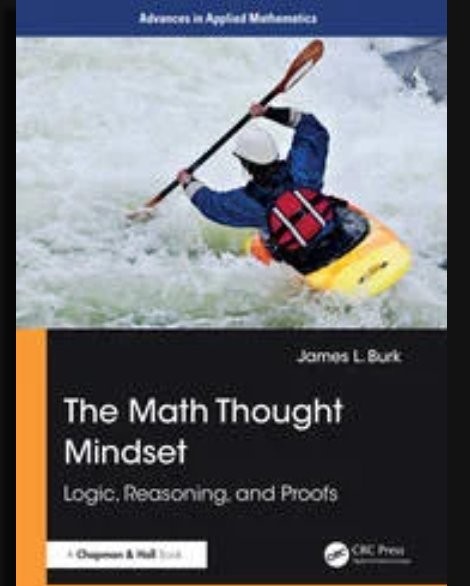
The Math Thought Mindset
Logic, Reasoning, and Proofs
ISBN 9781032959771 352 Pages 70 Color & 7 B/W Illustrations June 9, 2026 Chapman & Hall / CRC Press
Table of Contents
Ch. 1 Logic Basics
1.1Introduction
1.2Basic Logical Operators
1.3Logical Equivalences
1.4Conditional Statements
1.5Universal and Existential Quantifiers
1.6Negating Quantifiers
Chapter Challenge
Which of the following correctly expresses the negation of ∀x, P(x)?
Correct. The negation of ∀x, P(x) is ∃x, ¬P(x). The universal claim says 'everything satisfies P'; to refute it, you only need one counterexample. This is one of the most commonly misunderstood rules in Chapter 1.
Not quite. Negating a quantifier flips it: ∀ becomes ∃, and the predicate gets negated too. Think: to disprove 'all swans are white', you need to find one swan that is not white.
Ch. 2 Deductive Reasoning
2.1Introduction
2.2Valid Argument
2.3Rules of Inference
2.4Quantified Rules of Inference
2.5Heuristic Diagrams
Chapter Challenge
An argument is valid if and only if:
Exactly. Validity is about the logical relationship between premises and conclusion — not whether either is actually true. A valid argument with false premises can have a false conclusion. Validity guarantees truth-preservation, not truth itself.
Close, but not quite. Validity is a structural property, not a factual one. An argument can be valid with entirely false premises. The key test: can the conclusion ever be false if the premises are true?
Ch. 3 Elementary Set Theory
3.1Introduction
3.2Set Fundamentals
3.3Set Operations
3.4Element Chasing
3.5Set Identities and Laws
3.6The Pigeonhole Principle
Chapter Challenge
To prove A ⊆ B by element chasing, the correct structure is:
Right. Element chasing for A ⊆ B always begins: 'Let x be an arbitrary element of A.' Then you use the definitions and properties to show x must also be in B. This is Chapter 3's core technique.
Not quite. To prove containment A ⊆ B, you start from A, not B. Take an arbitrary x ∈ A and track it forward to show it lands in B. The direction matters critically.
Ch. 4 Proof Methods
4.1Introduction
4.2Grammar and Fundamentals
4.3Quantified Statements
4.4Direct Proofs
4.5Indirect Proofs: Contradictions
4.6Indirect Proofs: Contrapositive
4.7Mathematical Induction
4.8Strong Mathematical Induction
4.9Other Proof Methods
4.10Developing Conjectures
Chapter Challenge
The contrapositive of 'If P then Q' is:
Perfect. The contrapositive flips and negates both parts: ¬Q → ¬P. The crucial insight: a conditional and its contrapositive are logically equivalent — proving one proves the other. This is one of the most powerful tools in Chapter 4.
Not quite. The contrapositive is not the converse. You flip the direction AND negate both statements: P → Q becomes ¬Q → ¬P. The converse (Q → P) and inverse (¬P → ¬Q) are different — and neither is equivalent to the original.
Ch. 5 Boolean Algebra
5.1Introduction
5.2Boolean Algebra
5.3Canonical Forms: SOP and POS
5.4Karnaugh Maps
5.5Digital Circuits
5.6Universal Gates
Chapter Challenge
In Boolean algebra, which gate is considered universal — meaning any other gate can be built from it alone?
Correct. The NAND gate is universal: NOT, AND, OR, and any other logical function can be implemented using only NAND gates. NOR is also universal. This is why understanding Boolean algebra deeply — not just memorizing truth tables — matters in Chapter 5.
Not quite. While AND and OR are fundamental, neither alone can produce all Boolean functions (you can't get NOT from AND or OR alone). NAND (and NOR) are the universal gates — Chapter 5.6 explores exactly why.
Appendix
A.1 — Rules of Inferences
A.2 — Quantified Rules of Inferences
A.3 — Logic and Venn Diagrams
A.4 — Well-Ordering Principle
A.5 — List of Commonly Used Symbols
An Education That Counts®

Tired of doing
the work — but still
not getting it?
There's a reason.

Math class taught you how to follow steps. But steps without understanding break the moment anything changes. The Math Thought Mindset changes that — by teaching you to reason, not just calculate.

⭐ BBB A+ Accredited
📖 CRC Press · June 2026
✓ Free to Start
The Math Thought Mindset — Dr. James L. Burk, CRC Press 2026
CRC Press · June 2026
ISBN 9781032959771 352 Pages 70 Color & 7 B/W Illustrations Chapman & Hall June 9, 2026
Click book to explore contents
Logic Reasoning Proof Set Theory Quantifiers Contradiction Induction Uniqueness Elegance Rigor First Principles Understanding Logic Reasoning Proof Set Theory Quantifiers Contradiction Induction Uniqueness Elegance Rigor First Principles Understanding Logic Reasoning Proof Set Theory Quantifiers Contradiction Induction Uniqueness Elegance Rigor First Principles Understanding Logic Reasoning Proof Set Theory Quantifiers Contradiction Induction Uniqueness Elegance Rigor First Principles Understanding
The Math Thought Mindset
Logic, Reasoning, and Proofs
ISBN 9781032959771 352 Pages 70 Color & 7 B/W Illustrations June 9, 2026 Chapman & Hall / CRC Press
Table of Contents
Ch. 1 Logic Basics
1.1Introduction
1.2Basic Logical Operators
1.3Logical Equivalences
1.4Conditional Statements
1.5Universal and Existential Quantifiers
1.6Negating Quantifiers
Chapter Challenge
Which of the following correctly expresses the negation of ∀x, P(x)?
Correct. The negation of ∀x, P(x) is ∃x, ¬P(x). The universal claim says 'everything satisfies P'; to refute it, you only need one counterexample. This is one of the most commonly misunderstood rules in Chapter 1.
Not quite. Negating a quantifier flips it: ∀ becomes ∃, and the predicate gets negated too. Think: to disprove 'all swans are white', you need to find one swan that is not white.
Ch. 2 Deductive Reasoning
2.1Introduction
2.2Valid Argument
2.3Rules of Inference
2.4Quantified Rules of Inference
2.5Heuristic Diagrams
Chapter Challenge
An argument is valid if and only if:
Exactly. Validity is about the logical relationship between premises and conclusion — not whether either is actually true. A valid argument with false premises can have a false conclusion. Validity guarantees truth-preservation, not truth itself.
Close, but not quite. Validity is a structural property, not a factual one. An argument can be valid with entirely false premises. The key test: can the conclusion ever be false if the premises are true?
Ch. 3 Elementary Set Theory
3.1Introduction
3.2Set Fundamentals
3.3Set Operations
3.4Element Chasing
3.5Set Identities and Laws
3.6The Pigeonhole Principle
Chapter Challenge
To prove A ⊆ B by element chasing, the correct structure is:
Right. Element chasing for A ⊆ B always begins: 'Let x be an arbitrary element of A.' Then you use the definitions and properties to show x must also be in B. This is Chapter 3's core technique.
Not quite. To prove containment A ⊆ B, you start from A, not B. Take an arbitrary x ∈ A and track it forward to show it lands in B. The direction matters critically.
Ch. 4 Proof Methods
4.1Introduction
4.2Grammar and Fundamentals
4.3Quantified Statements
4.4Direct Proofs
4.5Indirect Proofs: Contradictions
4.6Indirect Proofs: Contrapositive
4.7Mathematical Induction
4.8Strong Mathematical Induction
4.9Other Proof Methods
4.10Developing Conjectures
Chapter Challenge
The contrapositive of 'If P then Q' is:
Perfect. The contrapositive flips and negates both parts: ¬Q → ¬P. The crucial insight: a conditional and its contrapositive are logically equivalent — proving one proves the other. This is one of the most powerful tools in Chapter 4.
Not quite. The contrapositive is not the converse. You flip the direction AND negate both statements: P → Q becomes ¬Q → ¬P. The converse (Q → P) and inverse (¬P → ¬Q) are different — and neither is equivalent to the original.
Ch. 5 Boolean Algebra
5.1Introduction
5.2Boolean Algebra
5.3Canonical Forms: SOP and POS
5.4Karnaugh Maps
5.5Digital Circuits
5.6Universal Gates
Chapter Challenge
In Boolean algebra, which gate is considered universal — meaning any other gate can be built from it alone?
Correct. The NAND gate is universal: NOT, AND, OR, and any other logical function can be implemented using only NAND gates. NOR is also universal. This is why understanding Boolean algebra deeply — not just memorizing truth tables — matters in Chapter 5.
Not quite. While AND and OR are fundamental, neither alone can produce all Boolean functions (you can't get NOT from AND or OR alone). NAND (and NOR) are the universal gates — Chapter 5.6 explores exactly why.
Appendix
A.1 — Rules of Inferences
A.2 — Quantified Rules of Inferences
A.3 — Logic and Venn Diagrams
A.4 — Well-Ordering Principle
A.5 — List of Commonly Used Symbols
An Education That Counts®

Tired of doing
the work — but still
not getting it?
There's a reason.

Math class taught you how to follow steps. But steps without understanding break the moment anything changes. The Math Thought Mindset changes that — by teaching you to reason, not just calculate.

⭐ BBB A+ Accredited
📖 CRC Press · June 2026
✓ Free to Start
The Math Thought Mindset — Dr. James L. Burk, CRC Press 2026
CRC Press · June 2026
ISBN 9781032959771 352 Pages 70 Color & 7 B/W Illustrations Chapman & Hall June 9, 2026
Click book to explore contents
Logic Reasoning Proof Set Theory Quantifiers Contradiction Induction Uniqueness Elegance Rigor First Principles Understanding Logic Reasoning Proof Set Theory Quantifiers Contradiction Induction Uniqueness Elegance Rigor First Principles Understanding Logic Reasoning Proof Set Theory Quantifiers Contradiction Induction Uniqueness Elegance Rigor First Principles Understanding Logic Reasoning Proof Set Theory Quantifiers Contradiction Induction Uniqueness Elegance Rigor First Principles Understanding
Sound familiar?

You're not bad at math.
You haven't bridged the gap of understanding.

Most math courses teach you what to do. Almost none teach you why it works — or how to think when the problem doesn't match the template.

The shift that changes everything

Math isn't a list of procedures.
It's a way of thinking.

The students who truly master mathematics aren't the ones who memorized the most — they're the ones who learned to reason from first principles. To ask why. To build arguments from scratch. That skill is learnable. And that's exactly what this book teaches.

The Math Thought Mindset
Logic & Proof
Set Theory
Reasoning
The Answer

A new way to study math — built for real understanding.

The Math Thought Mindset: Logic, Reasoning, and Proofs doesn't just show you what to write — it changes how you think. Every chapter asks the questions your other textbooks skip. Published by Chapman & Hall / CRC Press, June 9, 2026.

Learn to reason from scratch — not just follow templates
Write proofs you can defend — with confidence, not guesswork
See how concepts connect — logic, sets, quantifiers, and proof
Build skills that transfer — to every course, every career challenge
ISBN 9781032959771 · 352 pp · June 9, 2026 · Chapman & Hall / CRC Press
What changes for you

This isn't a harder way to study. It's a smarter one.

01
Problems stop feeling random
When you understand the logic behind a concept, every variation becomes approachable — because you know the why, not just the how.
02
Proofs become second nature
You'll learn to read, write, and critique mathematical arguments — a skill that carries you through every advanced course.
03
You think like a mathematician
You stop asking "what formula?" and start asking "what do I know, and what follows from it?" That shift is everything.
04
Confidence that outlasts the exam
Memorized formulas fade within weeks. Reasoning skills don't. The understanding you build here stays with you — for life.
Dr. James L. Burk
Why This Book Works
Dr. James L. Burk
Associate Professor of Mathematics · Harding University, Searcy AR

Over 22 years in the classroom — from remedial algebra to graduate-level mathematics — I have watched smart students struggle not because they lacked ability, but because no one taught them how to think mathematically. I built the Math Thought Program, wrote this textbook, and have personally coached students to consistent A+ grades. My goal hasn't changed: help you understand the material — not just survive the exam.

22+Years Teaching
80%+Students reach A+
Ph.D. Mathematics, Washington State University (2012)
AP Calculus Exam Reader — College Board (2025) · Putnam Exam Supervisor (2014–present)
Published: Electronic J. Linear Algebra · Author, CRC Press / Chapman & Hall
Founder, Online Math Tutor LLC · BBB A+ · ACUE Credentialed Educator · An Education That Counts®
"Understanding is the real shortcut in mathematics."
MathThought Newsletter

Weekly insights. Study tips.
Delivered to your inbox.

College algebra through differential equations — Math Thought Mindset study strategies for every level, every week.

No spam · Unsubscribe anytime · An Education That Counts®
Watch the Thinking in Action

See how Math Thought
teaching works

Dr. Burk's YouTube channel covers college algebra, precalculus, calculus I–III, differential equations, linear algebra, discrete mathematics, and more — all taught through the Math Thought Mindset approach. Watch a lesson before you commit to anything.

College Algebra Precalculus Calculus I · II · III Differential Equations Linear Algebra Discrete Mathematics
▶  Visit the Full Channel
Try it yourself — right now

Can you catch
the mistake?

No formulas needed. No account required. Just see if you can spot what the student got wrong — and more importantly, why.

Reasoning ChallengeTry It Free
A student claims: "If A ⊆ B and B ⊆ C, then A = C."

Is this argument valid?
Exactly right. A ⊆ B ⊆ C gives us A ⊆ C — but C could contain elements never in A. The student confused subset with equality. Catching exactly this gap is what Math Thought Mindset trains you to do.
Not quite — but keep thinking. What does A ⊆ B ⊆ C actually guarantee? The flaw is in what's been assumed versus what's actually been proven.
Ready to think differently?

The book that changes
how you see mathematics.

Stop memorizing. Start understanding. The Math Thought Mindset gives you the reasoning skills that carry you through every math course you'll ever take.

ISBN 9781032959771 · 352 pp · June 9, 2026 · Chapman & Hall / CRC Press / Taylor & Francis · An Education That Counts®